
Transponder Chip IDs Explained: 4C, 4D, 8A, ID46, ID47, ID49, ID4A
Which chip each make uses, which ones clone, and the universal chips that cover them
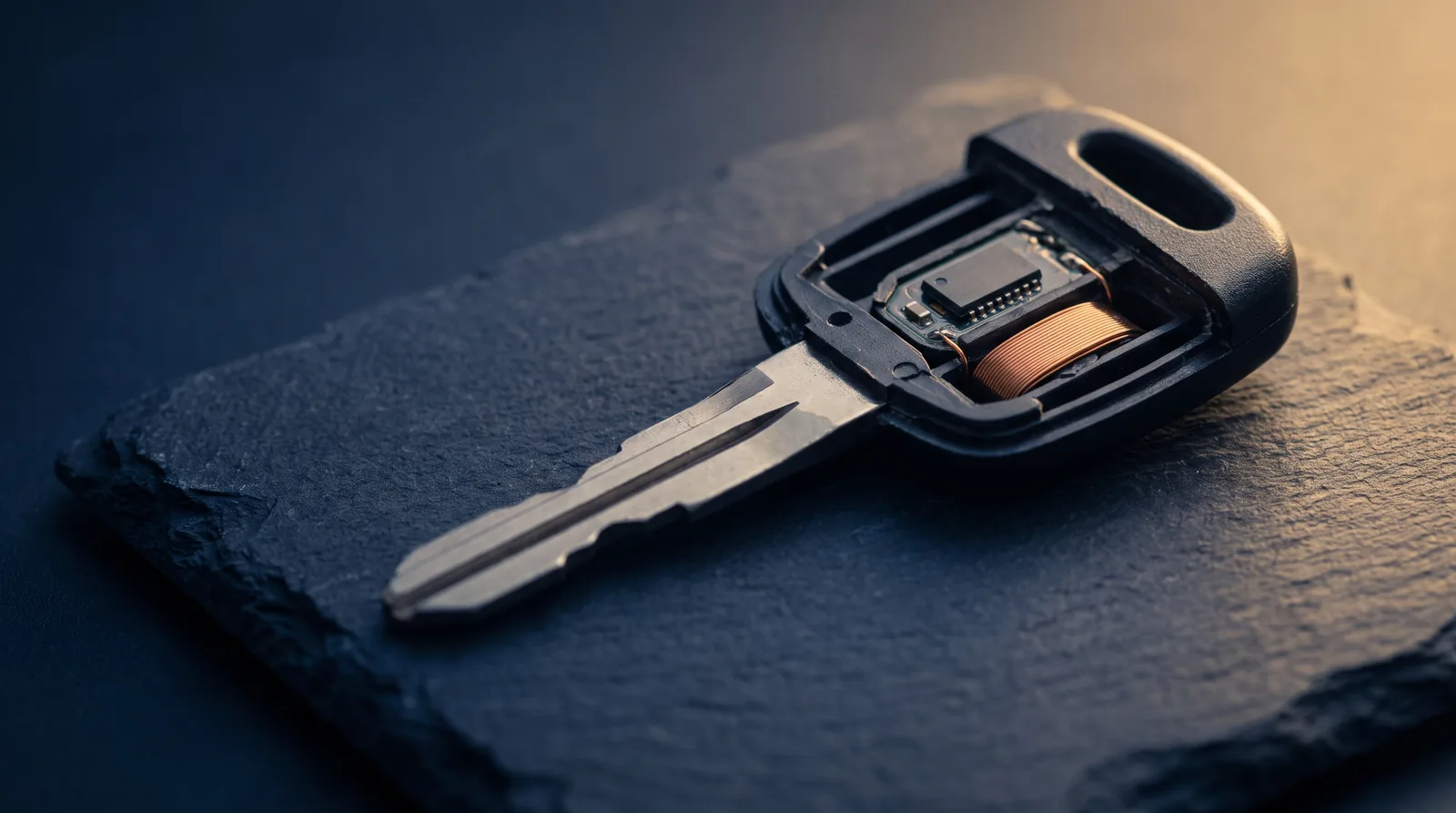
A transponder chip ID is the family name for the immobilizer chip inside a car key, and it tells you two things before you touch the vehicle: whether the key can be cloned or must be programmed, and which blank or universal chip will actually work. The families a North American locksmith meets most are Texas Instruments 4C, 4D and 8A (the Toyota "H" chip), NXP/Philips ID46 (Hitag 2), ID47 (Hitag 3), ID49 (Hitag Pro) and ID4A (Hitag AES), and Megamos 13, ID33 and ID48 (Megamos Crypto). Fixed-code and 40/80-bit chips (4C, 4D, 13, 33, 48, most 46) can be cloned onto a universal chip; ID47, ID49, ID4A and Megamos AES are programmed to the vehicle, not cloned.
Transponder chip families at a glance
The table below groups the chips by maker and by what a working tech needs to know. Year ranges are typical, not absolute; the same make can run two chip generations in the same model year, so verify against the vehicle or the FCC ID before you cut anything.
| Chip ID | Family / IC | Bit depth | Typical makes and years | Clone or program |
|---|---|---|---|---|
| 4C | TI fixed code | Fixed | Toyota/Lexus 1998–2006, early Ford PATS | Clone |
| 4D60 | TI DST 40-bit | 40-bit | Ford/Lincoln/Mazda 2000–2005, Hyundai/Kia flip keys | Clone |
| 4D63 (40-bit) | TI DST | 40-bit | Ford/Mazda/Mercury 2000s | Clone |
| 4D63 80-bit (DST80) | TI DST80 | 80-bit | Ford/Lincoln/Mazda 2011–2019 | Clone (80-bit capable tool) |
| 4D64 | TI DST | 40-bit | Chrysler/Dodge/Jeep 1998–2006 | Clone |
| 4D67 / 4D68 | TI DST "D" chip | 40-bit | Toyota/Lexus/Scion 2003–2013 | Clone |
| 4D72 "G" chip | TI DST80 | 80-bit | Toyota/Scion/Subaru 2010–2014 | Clone (80-bit capable tool) |
| 8A "H" chip | TI DST-AES | 128-bit | Toyota/Lexus 2013+, Subaru, Hyundai/Kia (RF430), Volvo | Clone on supported tools; program otherwise |
| ID46 | NXP Hitag 2 (PCF7936, 7941, 7945, 7952, 7953, 7961) | 48-bit crypto | GM, Chrysler, Honda/Acura 2003–2014, Nissan/Infiniti, Hyundai/Kia, Mitsubishi, BMW CAS, Porsche | Clone or program |
| ID47 | NXP Hitag 3 (PCF7938, PCF7953X, NCF29A1X) | 128-bit | Honda/Acura 2013+, Hyundai/Kia 2015+, Nissan 2013–2016 | Program only |
| ID49 | NXP Hitag Pro (PCF7945P, NCF2951, NCF29A1V) | 128-bit | BMW FEM/BDC, Ford/Lincoln 2015+, Mazda 2012+, Land Rover, Mini, Volvo | Program only |
| ID4A | NXP Hitag AES (PCF7939M, 7953M, 7961M, NCF29A1M) | 128-bit AES | Nissan/Infiniti 2014+, Stellantis 2013+, Honda 2018+, Toyota 2019+ smart keys | Program only |
| Megamos 13 | Fixed code | Fixed | GM PK3 1997–2007, Honda 2002–2006 | Clone |
| ID33 | Philips fixed code | Fixed | VW/Audi mid-1990s, some early Nissan/Mazda | Clone |
| ID48 | Megamos Crypto | 96-bit | VW/Audi/Seat/Skoda 1998–2015, some Fiat and Volvo | Clone (with tool support) or program |
| Megamos AES | MQB platform | AES | VW/Audi 2015+ (MQB) | Program only |
Two newer entries: ATMEL AES "6A" chips appear on 2019+ Mazda and 2021+ Hyundai Elantra smart keys, and 8E is an Audi Q7 variant. Both are program-only.
How to tell which chip a key uses
Start with the FCC ID and the year. On a remote head key or smart key the FCC ID on the back shell maps to a chip family; the FCC ID lookup guide covers where to find it. In our catalog the chip is printed on every listing, so a search for the FCC ID or part number tells you the family without opening the key.
Examples straight from the catalog:
- Honda Accord 2008–2015 remote head key KR55WK49308: PCF7936A, Hitag 2, ID46.
- Honda CR-V 2015–2016 smart key ACJ932HK1210A: NCF2952X, Hitag 3, ID47.
- Honda Accord 2018–2022 smart key CWTWB1G0090: NCF29A3M, Hitag AES, ID4A.
- Ford F-150 2015–2017 smart key M3N-A2C31243300: NCF2951F, Hitag Pro, ID49.
- Toyota RAV4 2013–2020 smart key HYQ14FBA: 8A chip on the G (0020) board.
- Toyota Corolla 2019–2022 smart key HYQ14FBN: NCF29A1M, Hitag AES, ID4A.
- Nissan Rogue 2014–2021 smart key KR5S180144106: PCF7953M, Hitag AES, ID4A.
Honda is the clearest illustration of how a single make walks through three generations in ten years: ID46 through 2014, ID47 from 2013 to roughly 2021, ID4A from 2018 on the Accord and from 2022 on the Civic and CR-V. Overlap years are real, which is why the FCC ID matters more than the model year.
If you have no FCC ID (a plain transponder key), a tool read is the fallback. Any current cloner or programmer with a chip reader (Xhorse VVDI Key Tool Max Pro, KEYDIY KD-MAX, Autel KM100) will identify the family from the chip itself in a second or two.
Clone or program: what the chip decides
Cloning copies the transponder data from a working key onto a blank chip. The vehicle never knows a second key exists, no PIN or OBD session is needed, and the job takes minutes. It only works when the chip's data can be read and reproduced, which is true for fixed-code chips (4C, 13, 33), TI DST 40-bit and 80-bit (4D and G), most ID46, ID48 on tools that support it, and Toyota 8A H on current tools.
Programming registers a new chip with the vehicle's immobilizer over OBD or through an onboard procedure. It is the only route for ID47, ID49, ID4A and Megamos AES, and it is the route for any all-keys-lost job regardless of chip. Programming needs a compatible tool, sometimes a PIN or security access, and on some platforms a bypass for a secure gateway. The what is a transponder key guide covers the immobilizer side in more depth.
Rule of thumb for quoting: if the customer has a working key and the chip is in the clone column above, quote a clone. If they have no working key, or the chip is program-only, quote programming and check the tool's vehicle list before you commit.
Universal cloneable chips Car Key Source stocks
A universal chip emulates several chip families from one part, so you carry one bin instead of ten. The catalog carries these:
| Product | Emulates | Tool | Link |
|---|---|---|---|
| Xhorse XT27A Super Chip, 50-pack | 4C, 4D, 4D 80-bit, 8A (Toyota H), 46, 8C, and more | Xhorse VVDI Key Tool family | XT27A 50-pack |
| Xhorse XT57B Super Chip, single | New-generation universal programmable transponder | Xhorse VVDI Key Tool family | XT57B single |
| Xhorse XT57B Super Chip, bundles | As above, in 10s and 50s | Xhorse | XT57B 10-pack, XT57B 50-pack |
| KEYDIY ID 4C / 4D cloning chip, 10-pack | 4C and 4D families | KEYDIY KD-X2 | KEYDIY 4C/4D chip |
| KEYDIY ID48 VW glass cloning chip, 10-pack | ID48 Megamos Crypto | KEYDIY KD-X2 | KEYDIY ID48 chip |
| KEYDIY ID8A Toyota H chip, 10-pack | 8A (Toyota H) | KEYDIY KD-X2 | KEYDIY 8A H chip |
The Xhorse super chip is also built into the Xhorse Super Remote series, so a flip key such as the XEDS01EN 3-button super remote or the Toyota/Lexus-style XELEX0EN arrives with the chip fitted and only needs generating.
The tools that drive these chips are stocked too: the Xhorse VVDI Key Tool Max Pro, the KEYDIY KD-MAX, and the Autel KM100 kit. Brand hubs: Xhorse, KEYDIY, Autel.
Vehicle-specific transponder keys by chip
When you prefer a dedicated blank over a universal chip, the catalog lists cut-to-code transponder keys by family. A few examples, all aftermarket:
- Toyota TOY43AT4 with 4C chip, 1998–2006
- Toyota TOY44H with 8A H chip, 2013–2018
- Ford H92 with 4D63 80-bit, 2000–2015
- GM B99 with Megamos 13, 1997–2008
- GM B111 with ID46, 2005–2017
- Honda HO01 with Megamos 13, 2002–2006
- Chrysler Y164 with ID46, 2004–2019
- Nissan NI07 with 4A AES, 2014–2021
Every one of these is a plain key, so blade keyway matters as much as chip; the key blank and keyway guide pairs each blank with its Lishi tool.
Common mistakes with chip IDs
- Treating "4D" as one chip. A 4D60 blank will not stand in for a 4D63 80-bit, and a 40-bit cloner cannot clone a G chip. Match the sub-ID and the bit depth.
- Assuming every ID46 is the same. GM "46E" (PCF7937E) and Mitsubishi "46 MITS" are ID46 variants with their own parameters; universal chips handle them, but only when the tool is told which variant to write.
- Assuming a Hitag chip is cloneable because it says PCF. ID47, ID49 and ID4A carry NXP part numbers too, and they are program-only.
- Forgetting that a clone cannot be deleted from the vehicle later. It never took a key slot, so the car cannot erase it; tell the customer.
If a key or remote won't program on the vehicle we listed it against, it is refunded within 30 days of delivery and we pay the return freight. That guarantee covers the part matching the listing; it does not cover a chip family mismatch you chose against the vehicle, so check the ID first.
FAQ
Is the Toyota H chip the same as 8A?
Yes. "H" is Toyota's marking on the key blade and 8A is the Texas Instruments DST-AES chip family it uses; the KEYDIY and Xhorse listings call it 8A or H interchangeably.
Can an ID46 chip be cloned?
Most ID46 (Hitag 2) keys can be cloned onto a universal chip such as the Xhorse XT27A with a working original in hand. Some vehicles require the tool to collect data from the ignition first, and all-keys-lost still needs programming.
What is the difference between ID47, ID49 and ID4A?
They are three different 128-bit NXP families: ID47 is Hitag 3 (Honda, Hyundai/Kia, some Nissan), ID49 is Hitag Pro (BMW, Ford 2015+, Mazda, Land Rover) and ID4A is Hitag AES (Nissan 2014+, Stellantis, Honda 2018+, Toyota 2019+). None of the three is cloned; all are programmed to the vehicle.
Which chip does a 2019 Honda use?
It depends on the model and key type: a 2019 Civic or CR-V remote head key or smart key is ID47, while the 2018+ Accord smart key is ID4A. Confirm by FCC ID before ordering.
Does a universal chip work in an all-keys-lost job?
Yes, as long as the vehicle's chip family is one the universal chip can emulate and your programmer can write the new key to the immobilizer. In all-keys-lost you are programming, not cloning, so the tool and the vehicle's security access matter more than the chip brand.
Where does Megamos 13 show up?
On GM PK3 keys from roughly 1997 to 2007 (B99 blank), on 2002–2006 Honda HO01 keys and on some Buick and Pontiac B107 keys. It is a fixed-code chip and clones easily.
Get trade tips in your inbox
Programming guides, sourcing tips and new-stock drops for working locksmiths. No spam, unsubscribe anytime.
About the author
Written by the working locksmiths behind the Car Key Source trade desk — the people who answer the phone when a key will not program. Questions about a specific job? Email info@carkeysource.com.
Buying keys for a shop or van?
Trade pricing is for locksmiths and shops. One short form, free, no card. Most accounts are approved instantly.