
Transponder Keys Explained: Chips, Cloning & Programming
How immobilizer chips work, which chip families fit which makes, and when to clone a key versus program one.
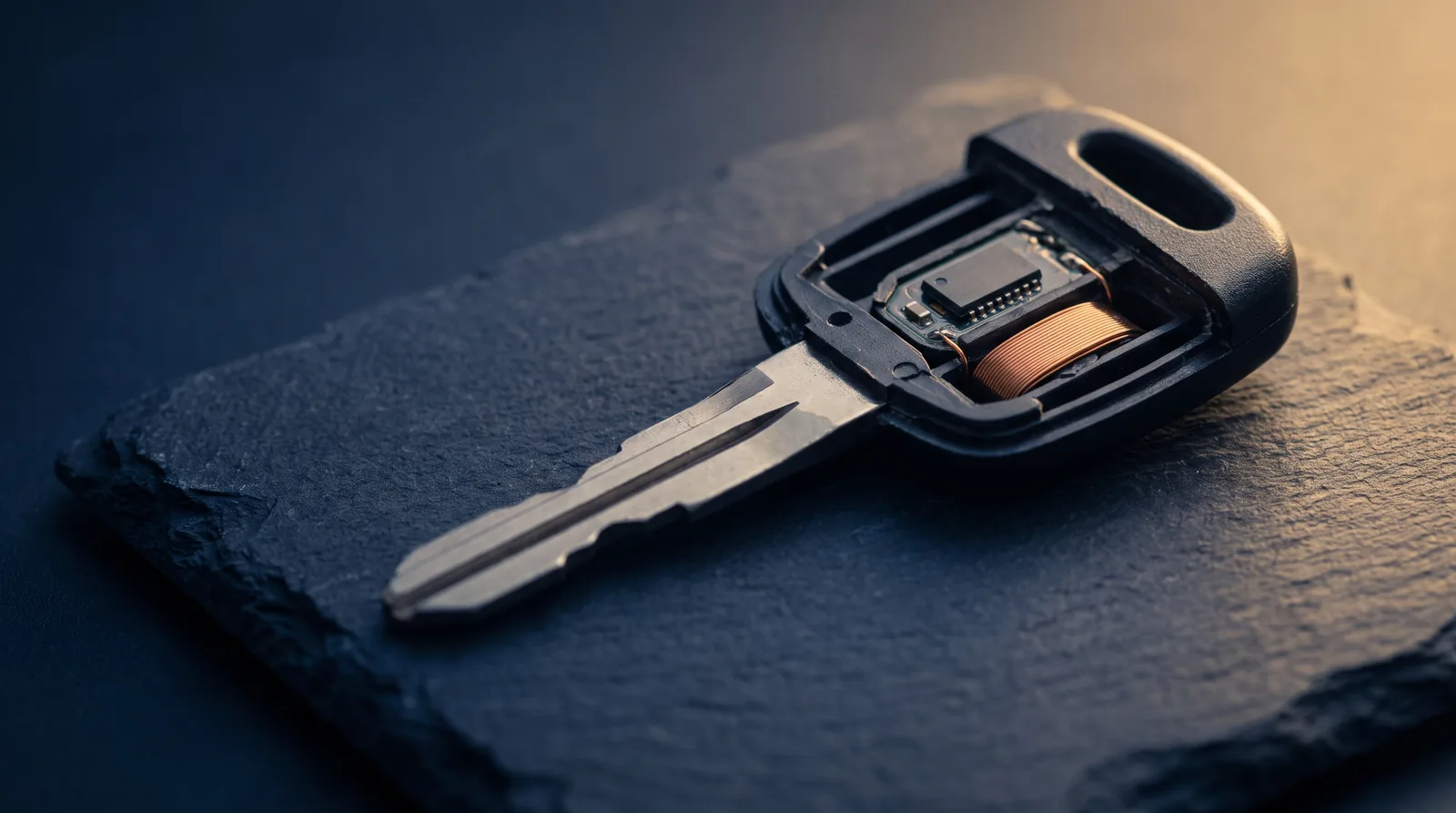
A transponder key looks like an ordinary metal car key, but sealed inside the plastic head is a small glass or ceramic RFID chip. When the key turns in the ignition, the vehicle's immobilizer reads that chip and checks its code against the codes stored in the car's computer. If the code matches, the engine is allowed to start. If it doesn't match — or if there is no chip at all — the engine will usually crank and then die, or refuse to fire entirely, even though the cut on the blade is perfect.
That one detail is behind most of the confusion around modern car keys, most "the new key turns but the car won't start" callbacks, and a good share of wasted stock. This guide covers how the system works, the major chip families and where you'll meet them, the difference between cloning and programming, and how to identify the right chip for a given vehicle before you order.
What a Transponder Key Is
"Transponder" is a contraction of transmitter and responder. The chip in the key head is a passive RFID device: it has no battery and does nothing until the immobilizer's antenna energizes it. Once powered, it transmits a stored identification code — or, on newer systems, a cryptographic response — that the vehicle either accepts or rejects.
Transponders arrived as an anti-theft measure in the mid-1990s. Hot-wiring and simple key copying had made car theft cheap, and electronic immobilizers made it expensive: without the right chip present, the engine computer withholds fuel, spark or the starter. European regulation required immobilizers on new vehicles by the late 1990s, Canada mandated them on new vehicles from 2007, and while the US never passed an equivalent rule, insurer pressure and manufacturer adoption meant that nearly every mainstream vehicle sold in North America since the early 2000s ships with one.
The practical consequence for anyone replacing keys: cutting the blade correctly is only half the job. A mechanically perfect key with the wrong chip — or no chip — will open the doors and turn the ignition, but the car stays dead.
How the Immobilizer Handshake Works
Around the ignition cylinder sits a ring antenna, sometimes called the induction coil. The sequence below runs in a fraction of a second every time the key is turned:
- Turning the key to ON powers the antenna ring, which generates a low-frequency field, typically at 125 kHz.
- The field induces just enough current in the chip to wake it — this is why the chip needs no battery of its own.
- On older fixed-code systems, the chip simply transmits its serial number. On crypto systems, the immobilizer sends a random challenge, and the chip must compute the correct response using a secret key stored inside it.
- The immobilizer compares the answer against its list of registered keys. On a match, it releases the engine control unit; on a mismatch, the vehicle typically flashes a security light and blocks starting.
The challenge-response design of modern chips is what separates them from simple RFID tags. Because the correct answer changes with every attempt, recording one exchange and replaying it later won't start the car — the chip has to actually hold the secret.
Push-to-start vehicles use the same principle with a different trigger. The emergency start procedure on most smart-key cars — holding the fob against the start button or a marked spot on the column — works because a backup antenna reads the transponder function inside the fob even when its battery is completely flat.
Transponder Chip Families
Chips are usually referred to by ID numbers (ID46, ID48 and so on) or by manufacturer family. The table below covers the families a working locksmith meets most often. Treat the makes as typical rather than absolute: coverage varies by year, model and market, and manufacturers switch systems mid-generation, so always confirm the specific vehicle before ordering.
| Chip family | Technology | Typical era | Commonly seen in |
|---|---|---|---|
| Fixed-code (ID11, ID12, ID13, ID33) | Fixed code, no encryption | Early to mid 1990s | Early VW, Honda, Mazda, Kia |
| Texas Instruments 4C | Fixed code | Mid 1990s to early 2000s | Ford, Toyota, Lexus |
| Texas 4D (DST40) | 40-bit crypto | Late 1990s to 2010s | Toyota, Ford, Mazda, Subaru, Mitsubishi |
| Texas DST80 / DST-AES | 80-bit and 128-bit crypto | 2010s to present | Toyota "G" and "H" keys, Ford |
| Philips/NXP ID46 (Hitag 2) | Crypto | Mid 2000s to 2010s | GM, Chrysler/Dodge/Jeep, Honda, Nissan, Hyundai, Kia |
| NXP Hitag 3 / Hitag AES (ID47, ID49, ID4A) | AES crypto | 2013 to present | Honda (ID47), Ford and Mazda (ID49), Hyundai and Kia (ID4A) |
| Megamos (ID48, Megamos AES) | Crypto and AES | 1997 to present | VW, Audi, SEAT, Škoda, Volvo, Fiat |
Two things are worth noting here. First, a single make can span several families — a 2004 Toyota and a 2016 Toyota need entirely different chips even if the blades look similar. Second, the same ID46 family appears across half a dozen brands, but the chips are configured differently per manufacturer, which is why blanks are sold as "ID46 for GM" or "ID46 for Chrysler" rather than as one universal part.
Transponder Key vs Remote vs Smart Key
The transponder chip and the remote are two separate systems that happen to live in the same piece of plastic, and keeping them separate in your head prevents a lot of mis-orders.
- The transponder is passive, works at very short range through the antenna ring, and exists purely to authorize starting the engine.
- The remote is an active, battery-powered transmitter — typically 315 MHz or 433 MHz in North America — that locks and unlocks the doors from a distance.
- A smart key combines both roles, adds passive entry and push-to-start, and keeps a backup transponder function for dead-battery starting.
So a remote head key contains a chip and a remote board; a basic transponder key contains only the chip; a separate keyless-entry fob on the customer's keychain contains only the remote. A dead fob battery kills the buttons but never the transponder, because the chip doesn't use the battery. If you're not sure which configuration you're holding, Car Key Types Explained walks through every one with identification pointers.
Cloning vs Programming: Two Different Jobs
There are two distinct ways to put a working chip in a customer's hand, and they suit different situations.
Cloning copies the data from an existing working key onto a special cloneable chip. The vehicle can't tell the copy from the original, because electronically it is the original — nothing on the car changes and no diagnostic session is needed. Cloning is fast and low-risk, which makes it the natural choice for a straightforward spare when the customer still has a working key. Its limits: you need that working key in hand, the chip family must be one your cloning tool supports — fixed-code, 4C, most 4D and many ID46 systems clone readily, while newer AES-generation chips are harder or not cloneable at all — and a clone doesn't occupy its own key slot in the car, so the vehicle still believes only the original keys exist.
Programming, also called adding or registering a key, writes a new chip into the vehicle's own key memory — usually through the OBD port with a programming tool, occasionally through an on-board procedure the manufacturer builds in. The new key gets its own identity in the immobilizer, and lost keys can be erased at the same time so they no longer start the car.
All keys lost changes the math completely. With no working key there is nothing to clone, so the only path is programming — and on many vehicles that means extra steps: retrieving a PIN or security code, longer OBD procedures, and on some models bench or EEPROM work on the immobilizer module itself. This is where professional programmers from Lonsdor and CGDI earn their keep, and it's why an all-keys-lost job should always be quoted differently from a duplicate.
The rule of thumb: working key present and a supported chip — clone it. No working key, an unsupported chip, or a customer who wants the lost key disabled — program.
How to Identify Which Chip a Car Needs
Ordering the wrong chip generation is the most common transponder mistake, and it's entirely avoidable:
- Start with year, make and model. Application charts map most vehicles to a chip family and keyway. Watch for mid-generation changeovers — a model can switch chip systems partway through a production run, so a broad year range in a chart deserves a second check for the exact year.
- Cross-check the FCC ID and part number whenever the key has a remote. The FCC ID printed on the fob ties the part to an exact radio and, in practice, to an exact configuration. Our guide to finding the FCC ID on a key fob shows exactly where to look.
- Confirm before you cut. The Find My Fob lookup matches vehicles to the correct part by year, make and model, FCC ID or part number, so the part that arrives is the one the immobilizer expects.
Transponder Key FAQ
Can I start a car without the transponder chip?
No — not on a vehicle with a factory immobilizer. A chipless copy will turn the lock and the ignition, but the immobilizer blocks the engine from running. The only real exception is a vehicle old enough, or a trim rare enough, to have no immobilizer at all, which is why pre-mid-1990s cars still run happily on plain metal copies.
Do all modern car keys have transponders?
Nearly all. Since roughly 2000 in North America — and by regulation since the late 1990s in Europe and 2007 in Canada — it's safe to assume a transponder is present unless the application chart says otherwise. A small number of base-trim and fleet vehicles from the early 2000s are the usual exceptions.
How do I know if my key has a chip?
The reliable answer comes from the bench: a transponder detector or cloning tool confirms a chip in seconds. Without tools, the clues are indirect — the vehicle is newer than about 2000, the key head is noticeably thick plastic, or the application data for the year, make and model lists a chip family. When in doubt, check the chart rather than assume; a wrong guess in either direction costs money.
Car Key Source is a trade-only wholesale supplier of transponder keys, remotes and smart keys for professional locksmiths across the US and Canada. Every listing is matched by FCC ID and part number and covered by our exact-fit guarantee, and orders placed by 4 PM ET ship the same day. Apply for a wholesale account or get an instant quote on the chips and keys you go through most.
Transponder keys we hold
Cloning only works when the blank and the chip family are both right. A few of the blanks that cover the most jobs:
- 2013–2021 Honda HO05 — G chip
- 2014–2021 Nissan Rogue / Kicks NI07-PT — AES chip
- 2011–2019 Ford H94-PT side mill — 4D63 80-bit
- 2008–2019 GM B120-PT — Philips ID46 circle plus
Every listing states the chip and test key. Browse the rest under transponder keys, or start from the vehicle.
Get trade tips in your inbox
Programming guides, sourcing tips and new-stock drops for working locksmiths. No spam, unsubscribe anytime.
So we can call you about fitment or your order.
About the author
Written by the working locksmiths behind the Car Key Source trade desk — the people who answer the phone when a key will not program. Questions about a specific job? Email info@carkeysource.com.
Buying keys for a shop or van?
Trade pricing is for locksmiths and shops. One short form, free, no card. Most accounts are approved instantly.