
Car Key Types Explained: Smart Keys, Flip Keys, Remote Head & Transponder
A working taxonomy of every key type on the bench — and what each one means for replacement, stocking and programming.
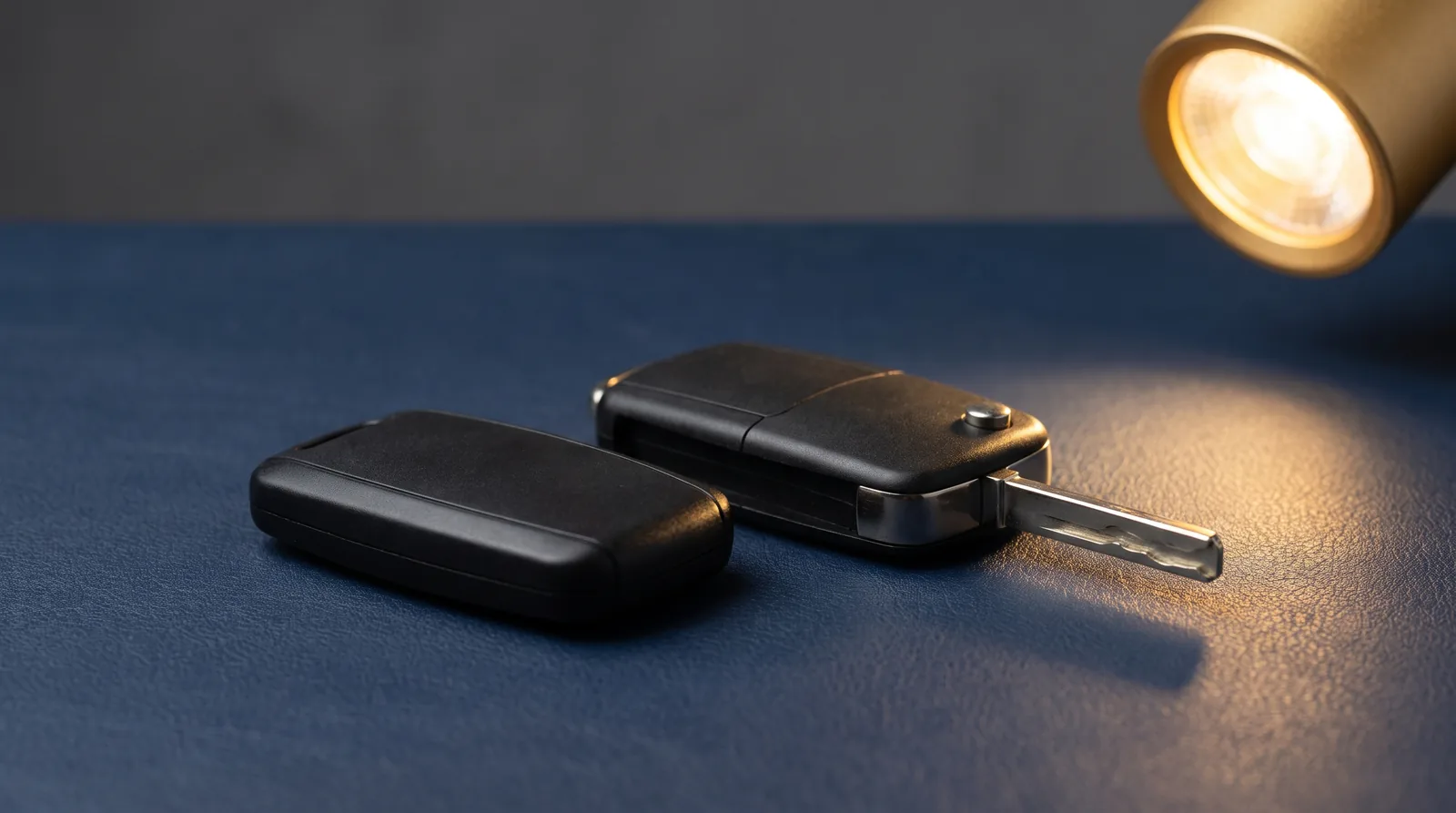
When a customer says "I need a new key fob," they might mean any of seven quite different products — and each one implies a different blank, a different chip situation, a different programming procedure and a different price. This guide is the full taxonomy: what each key type is, how it works, how to recognize it at a glance, and what replacing it actually involves.
Basic Mechanical Key
The original: a shaped metal blade, sometimes with a plastic head for grip, and nothing electronic anywhere in it. The cuts on the blade operate the lock cylinder mechanically, and that's the entire system.
How to identify it: all metal, or a thin plastic head with no bulk to it. No buttons, and the application chart for the vehicle lists no chip.
Replacement implications: duplicate from a working key or cut to code from the lock. No programming of any kind — which is why these are the cheapest keys to replace.
Typical vehicles: most cars built before the mid-1990s, plus some later base-trim and fleet vehicles. Mechanical-only keys also survive on many secondary locks — toolboxes, campers, older trunk cylinders.
Transponder Key
Externally similar to a mechanical key with a chunkier plastic head, but the head hides a passive RFID chip. The car's immobilizer challenges the chip every time the key turns; no valid chip, no start, regardless of how well the blade is cut. The full system — chip families, the immobilizer handshake, cloning versus programming — is covered in Transponder Keys Explained.
How to identify it: plastic head, no buttons, on a vehicle from roughly the late 1990s onward. If the car is newer than about 2000, assume a chip until the application chart says otherwise.
Replacement implications: cut the blade, then either clone the chip from a working key or program a new chip to the vehicle. All-keys-lost jobs are programming-only and should be quoted accordingly.
Typical vehicles: the default key across nearly all makes from the late 1990s through the 2010s, and still standard on many economy trims today.
Remote Head Key (RHK)
A remote head key rolls three things into one unit: a cut blade, a transponder chip, and a remote keyless entry board with lock and unlock buttons molded directly into the key's head. One object on the keyring starts the car and works the doors.
How to identify it: it's unmistakably a key — rigid blade, no folding — but the head carries buttons.
Replacement implications: three jobs in one part — cut the blade, program the chip, program the remote. On many vehicles a single OBD procedure registers chip and remote together; on others they're separate steps. Worn buttons with a good blade can often be solved with a shell swap instead of a full replacement.
Typical vehicles: enormously common on 2000s and 2010s Ford, Toyota, Honda and GM models, among many others. Browse our remote head key stock by make.
Flip Key (Switchblade)
Electronically, a flip key is a remote head key in a different package: the blade folds into the fob body and springs out at the press of a release button. VW and Audi popularized the style in the late 1990s and much of the industry followed.
How to identify it: press the release and the blade swings out. If the blade folds, it's a flip key — no exceptions.
Replacement implications: the same cut-plus-chip-plus-remote work as an RHK, with one addition: the flip mechanism is a mechanical wear point. Broken pivots and tired springs are common, so shell-and-blade repairs are a routine alternative to full replacement when the electronics still work.
Typical vehicles: VW and Audi from the late 1990s onward, and widespread on Chrysler, Dodge, Jeep, Hyundai, Kia, GM and Nissan models through the 2000s and 2010s. See current flip key inventory.
Keyless Entry Remote (RKE Fob)
A standalone transmitter that lives on the keyring next to a separate key. It locks, unlocks and triggers the panic alarm — and that's all. There is no blade and no immobilizer chip inside; starting the car is the separate key's job.
How to identify it: buttons but no blade, no slot for a blade, and the vehicle still has a conventional ignition that takes a metal key.
Replacement implications: remote programming only — no cutting, no immobilizer work. Many older vehicles support an onboard programming sequence a customer can even do themselves; others need a programming tool. Match the replacement by FCC ID to guarantee the radio is right, and see how to program a key fob for the general procedure.
Typical vehicles: very common on 1990s and 2000s GM and Ford models, and on base trims well into the 2010s. Browse keyless entry remotes.
Smart Key (Proximity Fob)
The current default: a buttoned fob that never has to leave the customer's pocket. The car and fob hold a short two-way radio conversation — the vehicle wakes the fob when a door handle is touched or the start button pressed, the fob answers cryptographically, and the car unlocks or starts. Inside the case there's also an emergency mechanical blade for the door and a backup transponder-style function that lets the car start with a completely dead fob battery, usually by holding the fob against the start button or a marked spot.
How to identify it: the vehicle has push-button start, and the fob has a release catch hiding an emergency blade.
Replacement implications: proximity programming is essentially always a tool job, and all-keys-lost on a smart-key vehicle is among the more involved tasks in automotive locksmithing — longer procedures, security codes on some makes, higher part cost. Quote smart-key work as its own tier.
Typical vehicles: luxury makes from the early 2000s, mainstream models from the mid-2000s onward, and the default on most new vehicles today. Browse smart keys and proximity fobs.
Universal and Programmable Remotes
The newest category isn't a vehicle key type so much as a locksmith's answer to all of the above: aftermarket remotes and smart keys that a programmer generates into the key a specific vehicle needs. Lonsdor's universal smart keys are the best-known example — one board family that the matching tool configures for a long list of applications. Xhorse, Keydiy and other tool makers run similar ecosystems.
What they solve: stock consolidation. Instead of shelving hundreds of vehicle-specific SKUs, a shop carries a handful of universal boards and shells and generates what each job needs — including coverage for odd applications that are hard to source as dedicated parts.
The trade-offs: you need the matching programmer ecosystem, the look and feel differ from the factory original, and coverage varies by system and vehicle — check the application list before promising a customer. Car Key Source does not stock universal boards or the tools that write them — our catalogue is vehicle-specific quality aftermarket keys and remotes, matched by FCC ID and part number, across every make we carry. Where a universal is the right answer for a job, generate it with your tool; where a dedicated part is, order the exact-fit one.
Quick Comparison
| Key type | Buttons | Transponder chip | Start method | Programming needed |
|---|---|---|---|---|
| Basic mechanical key | None | No | Blade in ignition | None |
| Transponder key | None | Yes | Blade in ignition | Chip (clone or program) |
| Remote head key | On the key head | Yes | Blade in ignition | Chip + remote |
| Flip key | On the fob body | Yes | Blade in ignition | Chip + remote |
| Keyless entry remote | Yes | No | Separate key | Remote only |
| Smart key | Yes | Yes (backup function) | Push button | Proximity programming (tool) |
| Universal remote | Yes | Yes (generated) | Varies by application | Generate, then program |
Car Key Types FAQ
What type is my key?
Work through it in order. No buttons anywhere: it's mechanical or transponder — the vehicle's year and application chart decide which. Buttons on a rigid key head: remote head key. Blade folds into the body: flip key. Buttons but no blade at all: it's an RKE remote if the car has a normal ignition, or a smart key if the car has push-button start and the fob hides an emergency blade.
Are smart keys and key fobs the same thing?
"Fob" is the umbrella word customers use for anything plastic on the keyring, so at the counter the terms blur. On the shelf they don't: a smart key specifically means proximity entry and push-button start, while an RKE fob only works the locks. Pin the part down by the car's start method and the FCC ID printed on the fob, not by the word the customer used.
Can a flip key replace a remote head key?
Only when a flip-style part is actually listed for that vehicle. The two are close cousins electronically, and vehicle-specific flip upgrades do exist for some applications — but the chip family, remote frequency and FCC ID or part number all have to match the vehicle. Replace like with like unless a listed alternative is confirmed, and when in doubt run the vehicle through Find My Fob before ordering.
Car Key Source stocks the vehicle-specific types on this page — transponder keys, remote head keys, flip keys, RKE remotes and smart keys — as quality aftermarket parts at trade-only wholesale pricing for professional locksmiths in the US and Canada. Every part is matched by FCC ID and part number under our exact-fit guarantee, with same-day dispatch on orders in by 4 PM ET. Apply for a wholesale account to see your pricing.
One of each, from the shelf
If you want to see how the six types differ in the hand, here is a live example of each from the catalogue:
- Transponder key — 2013–2021 Honda HO05, G chip
- Remote head key — 2017–2022 Honda Accord / Civic / CR-V, MLBHLIK6-1T
- Remote flip key — 2023–2025 Ford F-Series, N5F-A08TBLP
- Keyless entry remote — 2014–2022 Chevrolet / GMC, M3N32337100
- Smart / proximity key — 2017–2026 Ford Explorer / Expedition, M3N-A2C931426
- Fobik — 2014–2020 Jeep Cherokee, GQ4-53T
Or start from the vehicle instead of the type — keys by make and model.
Get trade tips in your inbox
Programming guides, sourcing tips and new-stock drops for working locksmiths. No spam, unsubscribe anytime.
So we can call you about fitment or your order.
About the author
Written by the working locksmiths behind the Car Key Source trade desk — the people who answer the phone when a key will not program. Questions about a specific job? Email info@carkeysource.com.
Buying keys for a shop or van?
Trade pricing is for locksmiths and shops. One short form, free, no card. Most accounts are approved instantly.