
How Smart Keys Are Programmed: Add-a-Key vs All Keys Lost
LF antennas, the immobilizer handshake, backup-slot placement, key-count limits and the board-number trap
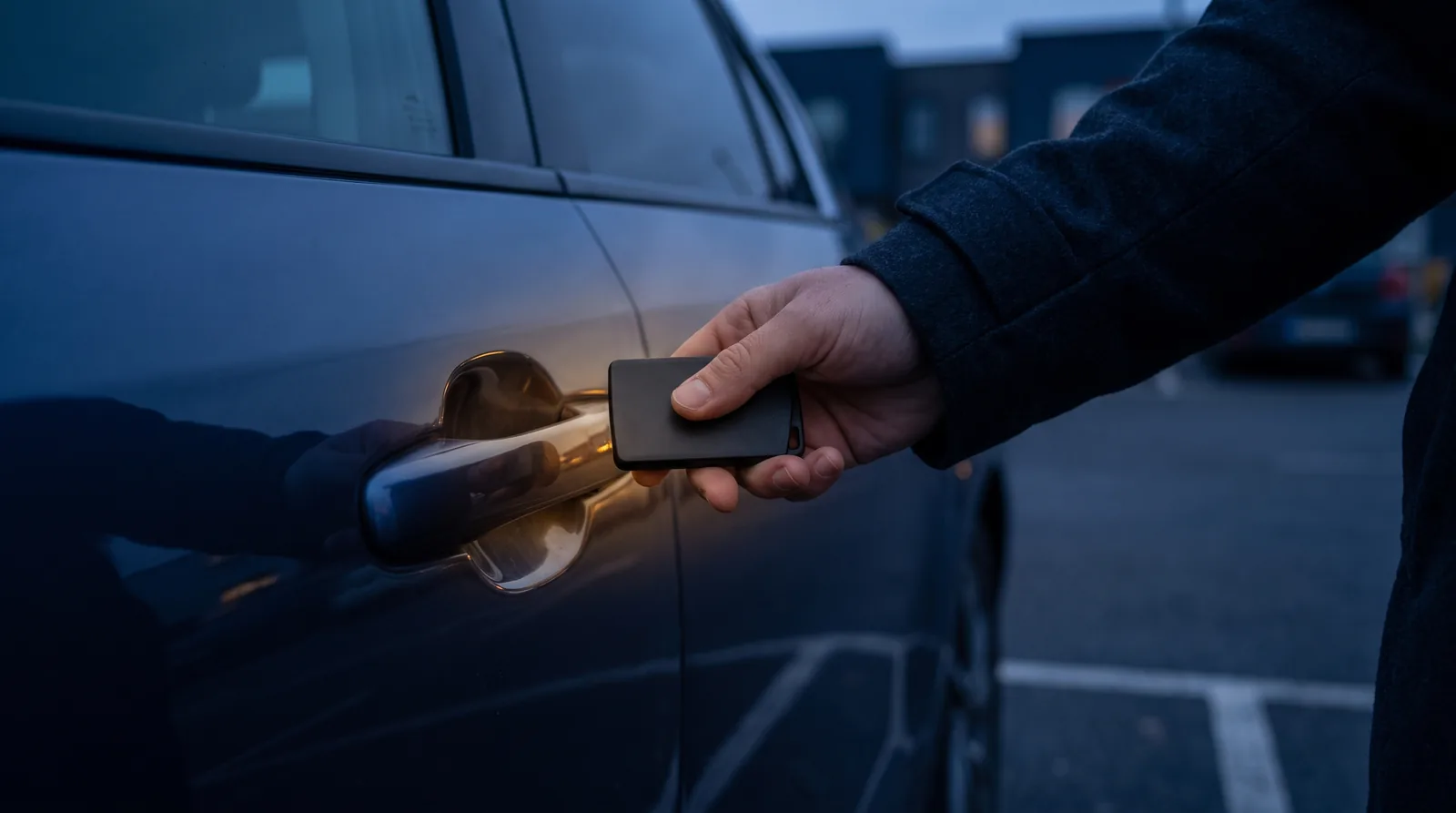
A proximity (smart) key is programmed by registering its unique transponder ID and rolling-code seed into the vehicle's certification or body control module, usually through the OBD port with a programming tool, while the fob sits on the start button or in a backup slot so the low-frequency antenna can read it. Add-a-key uses an existing registered key to authorize the new one; all-keys-lost has no working key, so the tool must reset or bypass the immobilizer first. On Toyota, Lexus and Subaru a smart key that has been registered once becomes locked to that vehicle, so used fobs are not a safe source of stock. The order of operations, the security access route and the key-count limit all depend on the make and year, so verify against the vehicle before you quote.
How a smart key actually pairs with the car
A smart key does two separate jobs and each has its own radio path. Remote lock and unlock run over a UHF transmitter in the fob (315, 433 or 902 MHz in North America, matched to the receiver in the car). Passive entry and push-button start run the other way: the car's low-frequency (LF) antennas, typically around 125 kHz, ping the cabin and door handles, and the fob wakes up and answers on UHF with an encrypted response.
The immobilizer handshake sits on top of that. When you press the start button the certification ECU (Toyota's name; Honda, Ford, Nissan and GM each have their own module) sends a challenge to the fob's transponder, the fob computes a response with the secret key that was written during registration, and only a correct answer releases the engine. Rolling code means each remote press or challenge uses a new counter value, so a captured transmission cannot be replayed.
Programming, then, is the act of writing that shared secret. The tool tells the module "accept this transponder ID" and, depending on the platform, either the car generates the secret and pushes it to the fob, or the tool writes matching data to both. That is why an unprogrammed fob does nothing on the car, and why a fob programmed to one car cannot simply be moved to another.
Add-a-key vs all-keys-lost: what changes
| Situation | What the tool needs | Typical route | Time and risk |
|---|---|---|---|
| Add-a-key (one working key present) | The existing key to authorize the session | OBD, often no PIN or a locally read PIN | Shortest job; lowest risk |
| All-keys-lost (no working key) | Security access: PIN from an online server, a seed-key calculation, or an immobilizer bypass | OBD plus bypass cable, emulator or module reset on some platforms | Longer; some platforms require module data download |
| Replacing a lost key while one remains | Same as add-a-key, plus erase the lost key | OBD erase-all-then-register on most platforms | Erase step means every remaining key must be present |
Add-a-key is the easier job because the car already trusts one transponder. Many platforms will accept a new key with nothing more than the existing key in the cabin and a session started through the OBD port. On some older systems an onboard procedure exists that needs no tool at all; the ones that apply to a given make are covered in how to program a key fob.
All-keys-lost removes that trust. The tool has to either obtain security access (a PIN pulled from the vehicle or from a manufacturer or tool-maker server) or work around the immobilizer entirely. Toyota and Lexus 8A systems are the well-known example: a tool such as an Autel IM-series unit or a Lonsdor programmer, with the appropriate bypass cable or emulator, resets the certification ECU so a fresh key can be registered. Ford PATS all-keys-lost usually means a timed security wait plus a PIN read, and Nissan and Honda have their own PIN or server routes. Make-specific detail is in the Toyota, Honda and Ford programming guides.
The practical difference for a mobile tech: on an add-a-key job you can walk up with the fob and the tool. On an all-keys-lost job you need to know before you leave whether the platform needs a bypass cable, a server token, or a module pull.
Where the fob goes while it programs
Because the fob's battery-fed UHF side is not what the immobilizer reads, most cars need the fob physically close to a dedicated LF coil so the transponder can be energized and read. The location is not standard.
| Placement | Makes that commonly use it | Notes |
|---|---|---|
| Held flat against the start button | Toyota, Lexus, Honda, Acura, Nissan, Infiniti, many Ford and Stellantis models | The button doubles as the backup reader; the tool's on-screen prompt tells you when to touch it |
| Backup slot in the dash or console | Older Nissan and Infiniti, some Mazda, some Hyundai and Kia | A slot with a fob-shaped opening; the fob is inserted like a card |
| Console pocket or cup-holder pocket | Some GM vehicles | A marked pocket with the transponder coil underneath |
| Steering-column pocket | Some European platforms | Check the owner's manual "dead key fob" procedure |
The owner's manual's "what to do if the key battery is dead" page is the fastest way to find the reader on an unfamiliar car, because that is exactly the same coil the programmer relies on.
Why a used smart key usually will not work
A brand-new smart key ships with a blank transponder. During registration the car writes its own secret data into the chip and, on many platforms, sets a lock bit so the data cannot be rewritten. Once that happens the fob is married to one VIN.
- Toyota and Lexus: 4D, 8A (H) and 8A-BA smart keys lock on first registration. A used HYQ14FBA or HYQ14FBX fob from another car will read as "already registered" and be rejected. Some tools offer a renew or unlock function for specific board generations; treat that as a tool-dependent exception, not the rule.
- Subaru: Subaru's Denso-based smart keys behave the same way, which is why the aftermarket LT20 boards for Subaru exist.
- Other makes: many Honda ID47 smart keys, most Ford ID49 PEPS keys and a number of Hyundai and Kia keys also lock, while some GM and Stellantis 46-chip fobs can be renewed by tools that support key renew. The honest answer is "check whether your tool lists a renew function for that FCC ID before you count on it".
For a locksmith, the working rule is simple: stock new fobs, and do not accept a customer's second-hand fob from a salvage yard as the basis of a quote unless you have already confirmed the tool can unlock it.
What each class of tool does on a smart-key job
| Tool | Role in a smart-key job | Typical use |
|---|---|---|
| OBD immobilizer programmers (Autel MaxiIM IM508 and IM608, Lonsdor K518, Xhorse VVDI Key Tool Max Pro with its OBD cable) | Talk to the vehicle: read PIN, erase and register keys, reset modules for all-keys-lost | The core of both add-a-key and all-keys-lost |
| Remote generators (Autel KM100, Xhorse Key Tool series, KEYDIY KD-X2 and KD-MAX) | Configure a universal smart key so it presents the correct FCC ID, frequency and chip type | Done before the OBD step when a universal remote is used instead of a vehicle-specific fob |
| Lonsdor KW100 | Bluetooth generator dedicated to Lonsdor LT20 Toyota and Lexus boards, supporting add-key and all-keys-lost use | Pairs with LT20 boards, then the vehicle is registered by OBD |
| Emulators and bypass cables | Stand in for a missing key or bridge the certification ECU on Toyota 8A and similar systems | All-keys-lost only |
The Xhorse VVDI Key Tool Max Pro is stocked with its OBD-to-DB15 cable, and the Lonsdor KW100 is stocked both alone and as the KW100-S kit with two LT20 boards. The Autel KM100 kit ships with IKEY universal smart keys. Which one belongs in your van is covered in choosing a key programmer.
Key-count limits
Every smart-key system has a maximum number of registered keys, and the tool will refuse to add a key when the slot list is full. The limit is platform-specific rather than universal; Toyota's smart-key systems, for example, allow more registered keys than most owners ever hold, while some other makes cap lower. Two habits avoid surprises: read the current key count before you promise an add-a-key, and when the count is full, run an erase-all followed by re-registration with every key the customer wants to keep present in the vehicle. Any key that is not present during the erase is gone.
The FCC ID and board-number trap
Matching the FCC ID is necessary but not sufficient. Toyota and Lexus reuse a single FCC ID across several incompatible circuit boards. HYQ14AAB exists as a 0140 board and a 3370 board; HYQ14FBA exists as a G board (0020) and a later H board; HYQ14ACX carries a GNE 5290 board; HYQ14ADR on the Sienna is a 5691 board. Register the wrong board and the car will refuse the key even though the label matches. The board number is printed on the PCB itself, and Car Key Source lists it in the product title where it matters, for example the 2007–2013 Toyota HYQ14AAB 0140-board smart key, the HYQ14AAB 3370-board version and the 2012–2020 HYQ14FBA G-board 0020 key.
Honda's equivalent trap is the part-number suffix and driver number: KR5V2X covers several 72147 part numbers with different button layouts and driver assignments, and a Driver 1 fob will not register as Driver 2. Ford's M3N-A2C31243300 family splits by button count and frequency. When the FCC ID is shared, confirm the part number and board before you order; find FCC ID on a key fob explains where each is printed.
What Car Key Source stocks for smart-key work
| Item | Use |
|---|---|
| Xhorse VVDI Key Tool Max Pro | Remote generation plus OBD programming with the included cable |
| Lonsdor KW100 | LT20 Toyota and Lexus board generation, add-key and all-keys-lost |
| Lonsdor LT20-10-4 board (HYQ14FBX, 8A-BA) | 2020–2024 Toyota and Lexus smart keys |
| Lonsdor LT20-02 Subaru board | Subaru 4-button smart keys, 8A and 4D |
| Autel KM100 kit with IKEY remotes | Universal smart-key generation |
| 2016–2021 Honda KR5V2X 5-button smart key | Honda Pilot, CR-V, Civic add-a-key or all-keys-lost |
| 2014–2018 Ford M3N-A2C31243300 smart key | Ford Explorer, Lincoln MKC and MKX |
All of these are aftermarket unless the listing says genuine OEM; the genuine OEM range is at /oem. If a key or remote won't program on the vehicle we listed it against, it is refunded within 30 days of delivery and we pay the return freight.
FAQ
Can I program a smart key without a tool?
Almost never. A handful of older systems have onboard add-a-key procedures with two working keys, but nearly every push-button-start vehicle sold in the last fifteen years requires an OBD programmer, and all-keys-lost always does.
Why does the car say the key is already registered?
The fob has been locked to another vehicle. New smart keys ship blank; a used Toyota, Lexus or Subaru fob cannot be re-registered unless your tool has a renew function for that exact board.
Does add-a-key need the old key in the car?
On most platforms, yes. The existing key authorizes the session, and on many cars it must be touched to the start button or placed in the backup slot at the tool's prompt.
How do I know which board a Toyota smart key has?
Open the fob and read the number printed on the circuit board, or match the part number on the label. The FCC ID alone is not enough because Toyota reuses it across incompatible boards.
What happens if I erase keys during all-keys-lost?
Every key that is not present during the erase is removed from the vehicle permanently. Collect all of the customer's spares before you start.
Get trade tips in your inbox
Programming guides, sourcing tips and new-stock drops for working locksmiths. No spam, unsubscribe anytime.
About the author
Written by the working locksmiths behind the Car Key Source trade desk — the people who answer the phone when a key will not program. Questions about a specific job? Email info@carkeysource.com.
Buying keys for a shop or van?
Trade pricing is for locksmiths and shops. One short form, free, no card. Most accounts are approved instantly.