
Remote Head, Flip or Smart Key: Which Does the Customer Need?
Identify what the vehicle shipped with, what can be converted, and what cannot be added
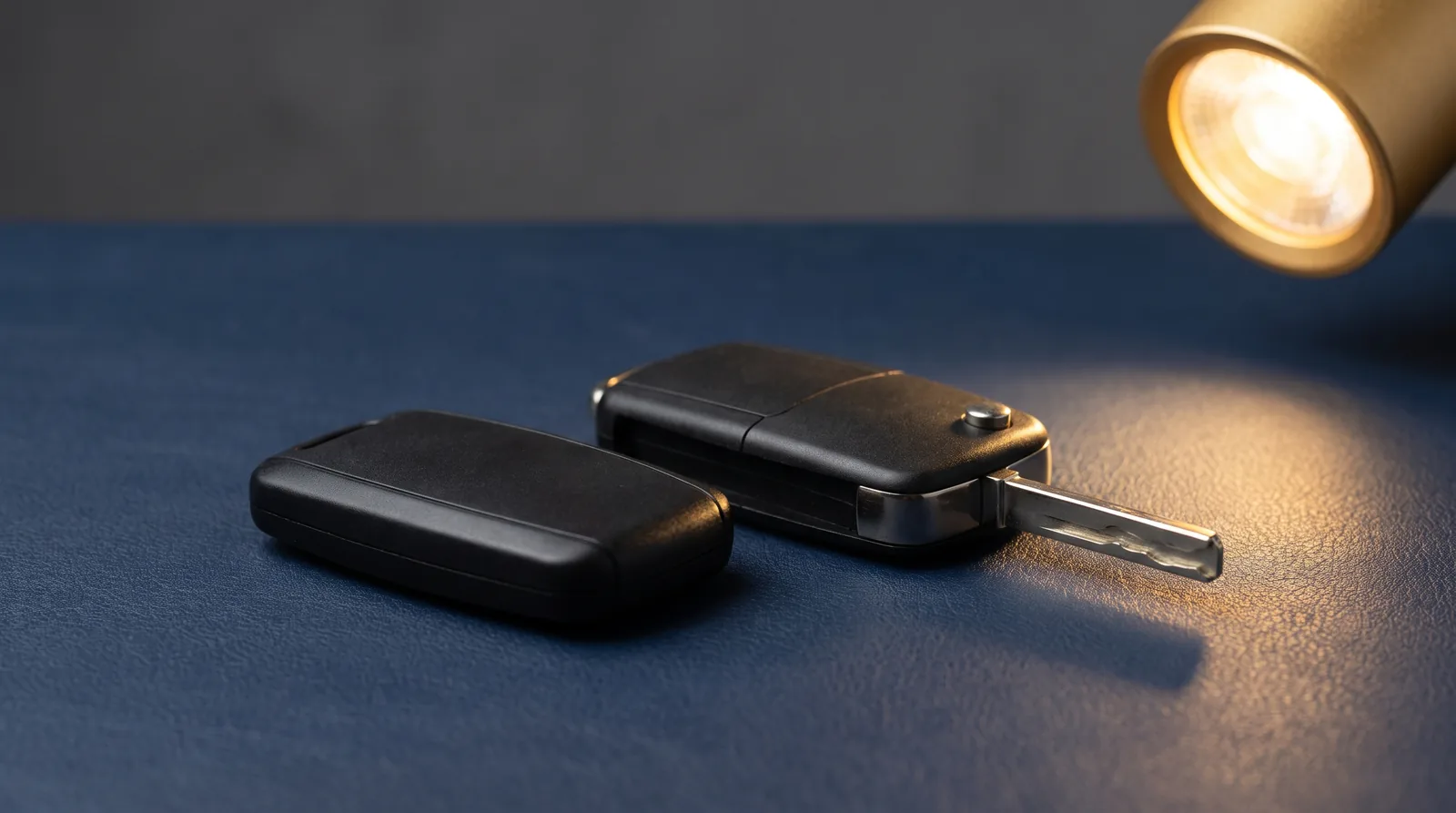
The customer needs whichever key type the vehicle's ignition system was built for, and the ignition tells you in seconds: a twist ignition with a metal key means a remote head key, a flip key, or a plain transponder key plus a separate keyless entry remote, while a push-button start means a smart (proximity) key. Within the twist-ignition group you can often move between styles, for example replacing a remote head key with a universal flip key that carries the same chip and remote data, because the car only cares about the transponder and the FCC ID. You cannot move across the boundary: a smart key cannot be added to a car without passive-entry hardware, and a remote head key cannot start a push-button car. Identify what the vehicle shipped with first, then decide whether an upgrade is possible.
The four key types in one table
| Type | What it is | Ignition | Contains | Programming |
|---|---|---|---|---|
| Transponder key (plus optional separate remote) | Metal key with a chip in the head; remote functions, if any, come from a separate keyless entry remote | Twist | Transponder chip only; the remote is a second unit | Chip to the immobilizer; remote separately to the body module |
| Remote head key | Metal key with the remote buttons built into the head | Twist | Transponder chip and remote board in one head | Chip and remote, usually in one session |
| Flip key | Remote head key with a folding blade | Twist | Same as remote head key | Same as remote head key |
| Smart key | Fob with no blade in use; emergency blade hidden inside | Push-button start (PEPS) | Transponder soldered to the board, plus LF receiver for passive entry | Registered through the OBD port as a proximity key |
The vehicle's platform decides which row applies. The distinctions in more depth are in car key types explained.
How to identify what the vehicle shipped with
Ask the customer three questions, or look for yourself.
- Is there a start button or a slot for a key? A start button means the car uses a smart key. A twist ignition means a chip key of some kind. Some 2000s Nissan, Infiniti and Mazda models have a twist knob with a fob slot; those are smart-key cars with an unusual interface, not remote head cars.
- Does the remote live in the key head or on a separate fob? On twist-ignition cars, if the buttons are on the key itself it is a remote head or flip key. If the customer has a plain key and a separate remote on the ring, the vehicle uses a transponder key plus keyless entry remote, and the two are replaced and programmed separately.
- Does the blade fold? A folding blade is a flip key. Mechanically it is the same as a remote head key with a hinge, and most flip keys share their chip and FCC ID with a fixed-blade equivalent.
Then confirm with the FCC ID printed on the back of the fob, since that is what actually has to match. The find my fob lookup and the FCC ID hub resolve an FCC ID or part number to the exact key and its type.
One model can span two types. The 2015–2017 Toyota Camry, for example, shipped with a HYQ12BBY remote head key on twist-ignition trims and a HYQ14FBA smart key on push-button trims. Same year, same model, different key, and the ignition is the only reliable tell.
What can be upgraded
Within the twist-ignition family, the car recognises two things: the transponder chip type and the remote's FCC ID and frequency. Anything that carries the right pair will work, which opens some useful swaps.
| Customer has | Customer wants | Possible? | Route |
|---|---|---|---|
| Remote head key | Flip key | Usually | A vehicle-specific flip key with the same FCC ID, or a universal flip remote generated to the vehicle's FCC ID with the correct chip and a cut blade |
| Flip key | Remote head key | Usually | Reverse of the above; a fixed-blade key with matching data |
| Transponder key plus separate remote | Remote head key | Sometimes | Only if a remote head key exists with the vehicle's remote data and chip; otherwise the two units stay separate |
| Plain transponder key, no remote | Any remote | Only if the car has a receiver | If the vehicle was never fitted with keyless entry, no remote will work |
| Remote head or flip key | Smart key | No | The car has no passive-entry hardware |
| Smart key | Remote head key | No | The car has no ignition cylinder that reads a chip |
The universal flip conversion is the common one. Xhorse, KEYDIY and Lonsdor sell flip-style universal remotes in Ford, GM, Honda, Toyota, Hyundai and Nissan styles; the generator tool writes the vehicle's FCC ID and chip type into the remote, a blade is cut, and the car is programmed exactly as it would be for a remote head key. A GM owner with a 2006–2016 OUC60270 keyless entry remote and a separate chip key can end up with one KEYDIY NB18 GM-style flip key or Xhorse XNBU01EN GM-style flip, provided the tool supports that vehicle's remote and chip combination. Verify the chip: a 46-chip GM and a 4D-chip Toyota need different universal remotes, and the KEYDIY NB series carries an integrated ID46 while Xhorse XE super remotes use the XT27A super chip that can be set to several types. The universal ranges are at /universal.
The one rule: a universal conversion is a remote-head-class key. It does not add passive entry, and it cannot make a twist-ignition car behave like a push-button car.
What cannot be upgraded
- Adding a smart key to a non-PEPS car. Passive entry and push-button start need LF antennas in the doors and cabin, a start button, an electronic steering lock and a certification module. None of that can be retrofitted with a key.
- Using a remote head key on a push-button car. There is no cylinder for the blade and no coil in the right place to read the chip, so the car will not start.
- Adding remote functions to a car that never had a receiver. Some base trims shipped with a transponder key and no keyless entry. A remote head key will program its chip but the buttons will do nothing.
- Changing the chip type. A universal remote must be set to the chip family the immobilizer expects. The tool cannot make the car accept a different one.
- Changing frequency. A 315 MHz receiver does not hear a 433 MHz remote; the universal remote is generated to the car's frequency, not the other way round.
If the customer's expectations run past these limits, the honest answer is a full retrofit kit from the manufacturer or a different vehicle, not a key.
Decision table
| Ignition | Original key | What to sell | What to program |
|---|---|---|---|
| Twist, remote on the key head | Remote head key | Remote head key, or a flip conversion | Chip and remote, one session |
| Twist, folding blade | Flip key | Flip key, vehicle-specific or universal | Chip and remote |
| Twist, remote separate | Transponder key plus keyless entry remote | Both units, or a remote head key if one exists for that data | Chip via immobilizer, remote via body module |
| Twist, no remote at all | Transponder key | Transponder key | Chip only |
| Push-button | Smart key | Smart key, vehicle-specific or universal | Proximity registration via OBD |
What Car Key Source stocks in each type
| Type | Example |
|---|---|
| Remote head key | 2006–2013 Honda Civic / Acura N5F-S0084A, 2005–2012 Ford F-Series OUC6000022 |
| Flip key | 2015–2022 Ford F-Series N5F-A08TDA, 2015–2019 Hyundai Tucson TQ8-RKE-4F25 |
| Transponder key plus keyless entry remote | 2004–2015 Toyota GQ43VT20T remote with a TOY43AT4 4C transponder key |
| Smart key | 2016–2021 Honda KR5V2X, 2014–2018 Ford M3N-A2C31243300 |
| Universal flip for conversions | Xhorse XEKF20EN knife-type super remote, KEYDIY NB12-4 Ford-style |
| Universal remote head | Xhorse XKTO22EN Toyota-style wired remote head key |
All listed parts are aftermarket unless the listing says genuine OEM; the genuine OEM range is at /oem. Trade pricing is unlocked with an approved wholesale account — most applications are approved instantly; apply at /apply.
FAQ
Can a flip key replace a remote head key?
Yes on most twist-ignition vehicles. The car reads the transponder chip and the remote's FCC ID, and a flip key with matching data, vehicle-specific or universal, programs the same way.
Can I add a smart key to a car with a regular ignition?
No. Push-button start needs antennas, a start button and a certification module that were built into the car; a key cannot add them.
How do I know if a car uses a remote head key or a separate remote?
Look at the original key. If the buttons are on the key head it is a remote head key; if the customer has a plain key and a separate fob it is a transponder key plus a keyless entry remote.
Does a universal flip key need a different programming step?
It needs one extra step before the car: the generator tool writes the vehicle's FCC ID and chip type into the remote. After that it is programmed to the car like any remote head key.
Why does the same model have two different key types?
Manufacturers fit push-button start to higher trims and twist ignitions to base trims in the same year. The ignition, not the model, decides the key.
Get trade tips in your inbox
Programming guides, sourcing tips and new-stock drops for working locksmiths. No spam, unsubscribe anytime.
About the author
Written by the working locksmiths behind the Car Key Source trade desk — the people who answer the phone when a key will not program. Questions about a specific job? Email info@carkeysource.com.
Buying keys for a shop or van?
Trade pricing is for locksmiths and shops. One short form, free, no card. Most accounts are approved instantly.